AM62x Temperature and Power Environmental Stresstesting Results
The MitySOM-AM62 SOM (6254-TX-DAD-TI) was placed in the MitySOM-AM62 Development Kit and loaded into the environmental chamber with the following configuration:
- Industrial Temperature micro-SD used for boot media and reference filesystem
- Industrial Temperature USB stick loaded into one of the USB 2.0 HUB positions
- External USB connection made to PC (MitySOM-AM62 USB 2.0 Dual Role port configured as an RNDIS network device)
- Both ethernet ports connected to an internal network at 1 Gbps link rates.
- Micro-USB console port connected to external PC for console monitoring.
- Monitor (1920x1080p) connected to HDMI port.
Stress Test software was enabled on the MitySOM-AM62 to perform the following operations (continuously) during test:
- Running the "memtest" application on 256 MB of DDR4 memory
- Running nandtest continuously on the MitySOM-AM62 OSPI NOR partitions
- Running stress-drive tests on a USB stick partition.
- Running stress-drive tests on a MitySOM-AM62 eMMC device partition.
- Running stress-drive tests on a micro-SD card partition.
- Running the TI provided 3D walking man OpenGL graphics program
- Running a stats collection script which gathers CPU temperature, power / current draw, and CPU utilization
- Running iperf on eth0
- Running iperf on eth1
- Running iperf on usb0, configured as an RNDIS network device
Note: the OLDI interface was not run during this test. Running the OLDI interface will draw additional power in order to drive the LVDS output links.
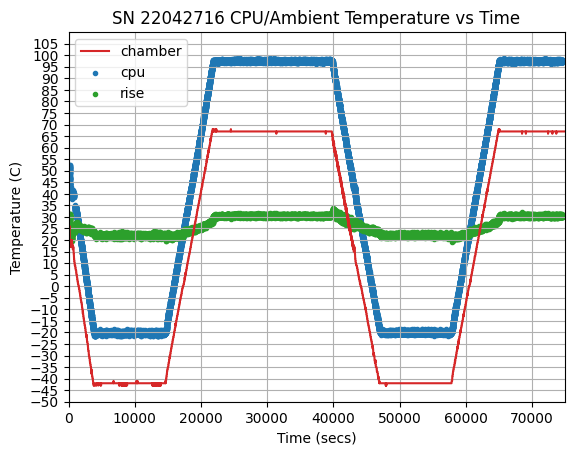
The system was allowed to run while the environmental chamber ranged from -45C to +65C, including soaks at each end of the range.
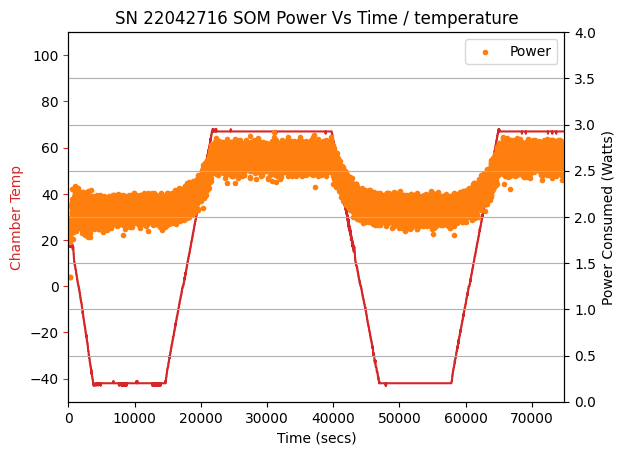
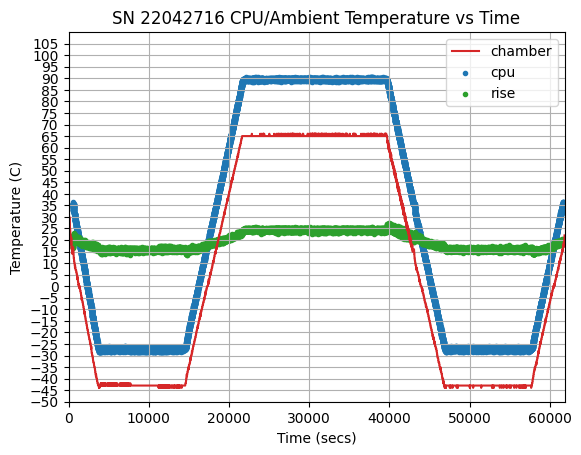
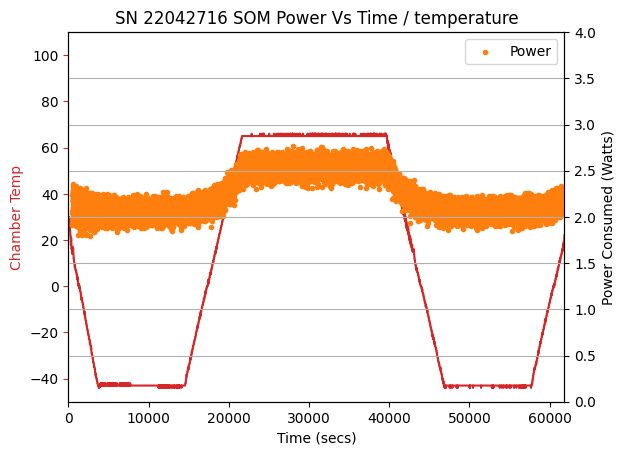
The figures below show the temperature of the AM62x (die temperature as reported by the kernel software), the chamber, the computed temperature rise, and the power consumed by the SOM.
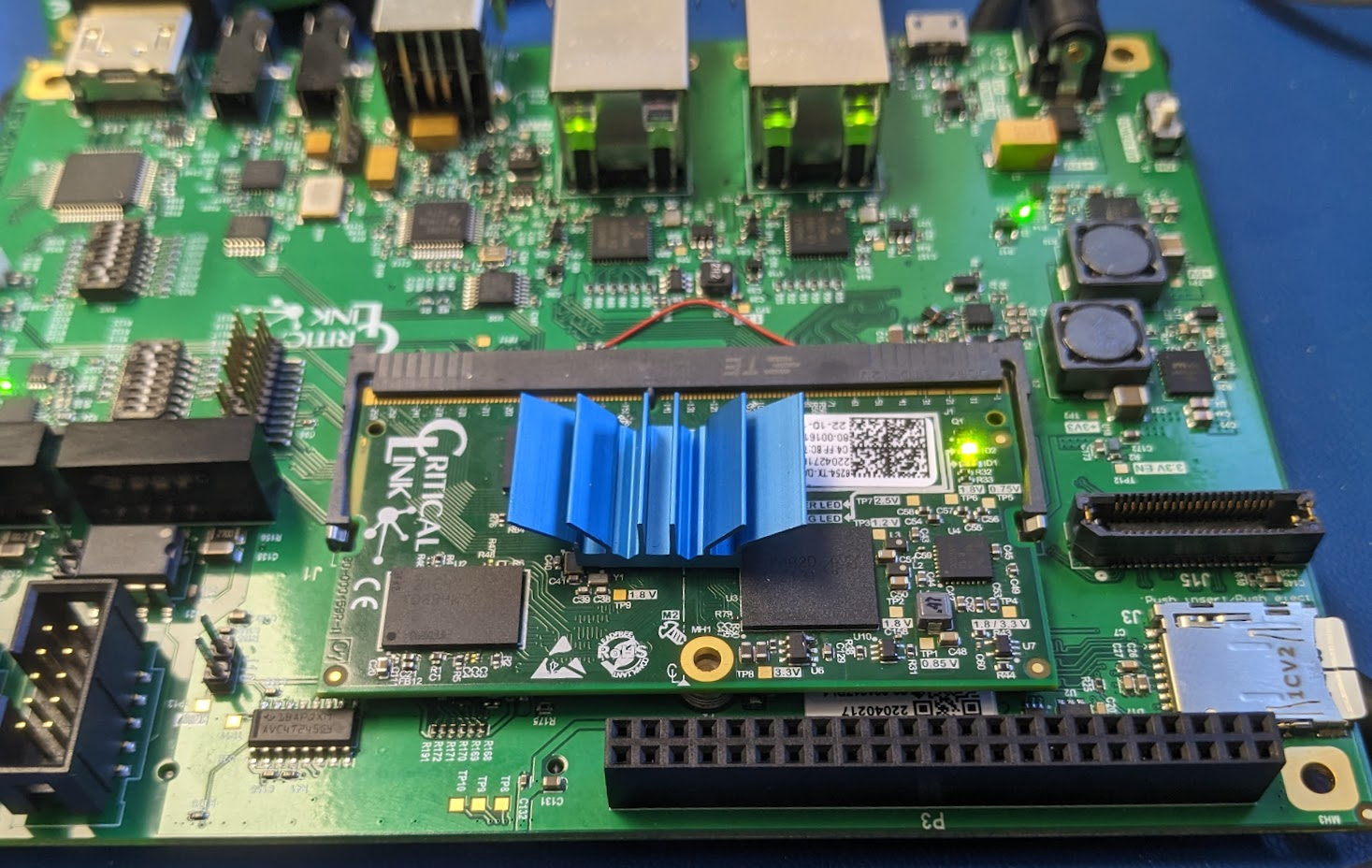
Stress Testing with passive heat sink attachment
As shown in the above results, when operating under relatively heavy load with the development kit, there is an approximate 35C rise in CPU die temperature over ambient temperature above 50C. The rise exceeds the maximum specified junction temperature of the processor (105C for industrial grade parts) when the ambient environment reaches approximately 70C. The testing was repeated with one unit using an off-the-shelf (ATS-52170B-C1-R0) passive heat sink attached to the processor. Results are included in the figures below. The overall CPU rise dropped to between 22-27C, which should allow ambient operation at up to approximately 78-80C. Under heavy loads, additional thermal management (e.g., a fan, or a larger heat sink, etc.) will be required.
Idle Testing with passive heat sink attachment
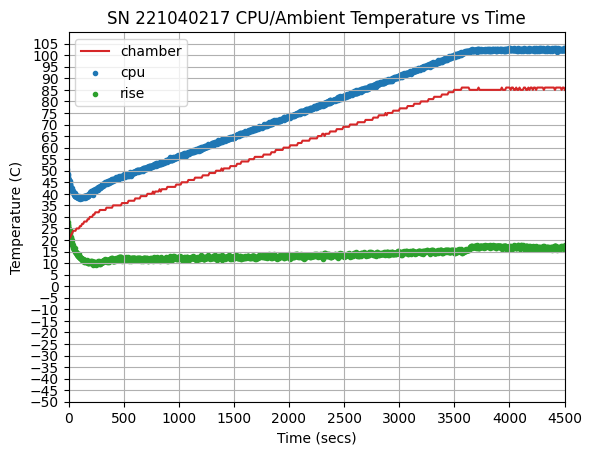
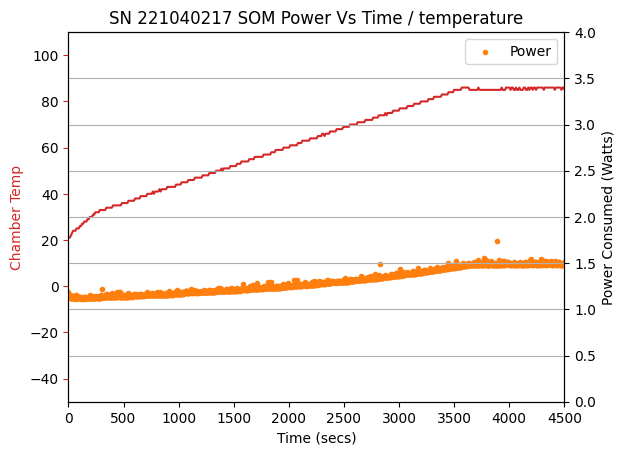
In this case, the same heat sink was attached as previously mentioned and the system was booted to Linux and no additional software was run (beyond the data logging software) while the chamber was ramped from +20 to +85C. The CPU governor selected was "on-demand", and the typical operating frequency selected was in the range of 200-400 MHz. From the figures, the power consumption of the SOM is much lower, and the unit was able to run at temperatures up to 85C ambient (though, just barely within the CPU 105C limit).
CPU Max Frequency vs. CPU temperature
Measurements where taken while running a stresstest and using cpu fan heatsinks FJ23 23mm BGA 5V Fansink with stick-on-pad.
The following tests were conducted using five 6254-TX-X9D-RI SOMs.
Ambient = 85C| CPU Max Frequency (Hz) | SOM0 CPU temp (C) | SOM1 CPU temp (C) | SOM2 CPU temp (C) | SOM3 CPU temp (C) | SOM4 CPU temp (C) |
| 1400000 | 108.8 | 102.7 | 104.8 | 102.1 | 103.8 |
| 1250000 | 102.1 | 98.4 | 100.3 | 97.5 | 99.8 |
| 1000000 | 101.4 | 98.2 | 99.9 | 97.2 | 99.1 |
| 800000 | 101 | 97 | 99 | 96.1 | 98.4 |
| 600000 | 100 | 96.5 | 98.2 | 95.9 | 97.3 |
| 400000 | 99.4 | 95.7 | 97.5 | 95.8 | 97 |
| 200000 | 97.7 | 94.5 | 97 | 94.5 | 95.7 |
echo <maxFreq> > /sys/devices/system/cpu/cpufreq/policy0/scaling_max_freq
Additional heat sinks
| Type | Model | Size | Idle Cpu Temp @ 65C Amb | Stress Cpu Temp @ 65C Amb |
| None | None | 90C | 99C | |
| Passive | ATS-52170B-C1-R0 | 17mm X 17mm X 7.5mm | 78C | 90C |
| Passive | ATS_52150B-C1-R0 | 15mm X 15mm X 7.5mm | 85C | 93C |
| Passive | Alum Heatsink for Raspberry PI | 15mm X 15mm X 15mm | 83C | 94C |
| Active | FJ23 23mm BGA 5V Fansink with stick-on-pad | 23mm X 23mm X 21mm | 80C | 87C |